
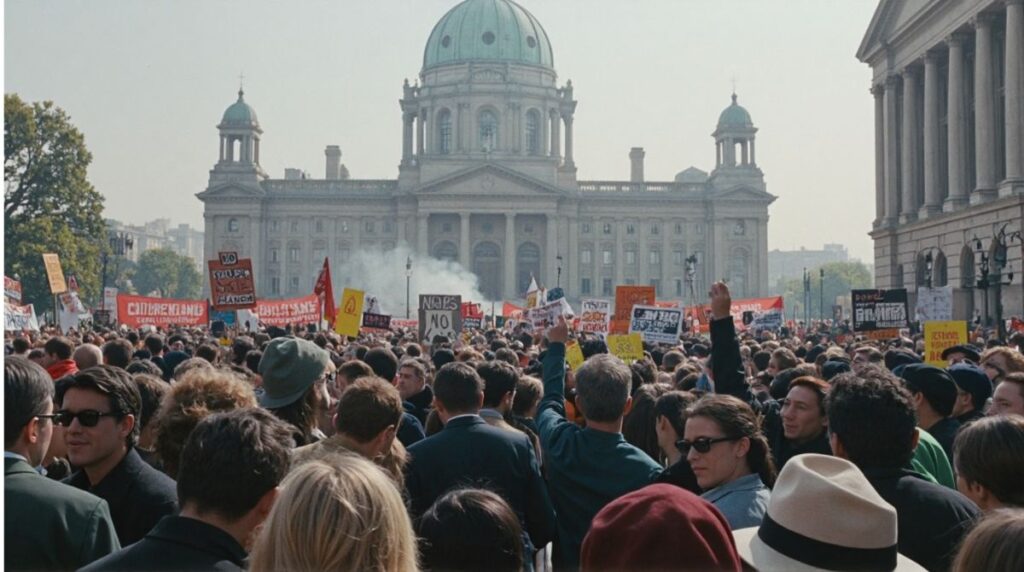
Washington, D.C. — As millions of Americans prepare for a second wave of “No Kings Day” protests this October, legal experts and political analysts warn that the specter of invoking the Insurrection Act could sharpen tensions between federal authority and civil dissent.
The No Kings movement, which first mobilized in June 2025, frames its protests as a defense of democracy against perceived authoritarian overreach by the Trump administration. Participants across more than 2,100 cities challenged the symbolism of a “kingly” presidency and militarized state presence. Organizers say the movement has grown more strategic, holding training sessions and issuing warnings about increasing political tension.
On Capitol Hill and in legal circles, calls for invoking the Insurrection Act are no longer theoretical. In past months, President Trump has hinted at using the law as a tool to deploy federal forces to cities experiencing protests or unrest, particularly in locals governed by Democratic administrations.<
Exclusive Offer for Our Readers!
Discover an amazing deal available only for our audience. Don’t miss out—act now!
What Is the Insurrection Act?
Passed in 1807, the Insurrection Act grants the President broad authority to deploy U.S. military forces (including the National Guard under federal control) within U.S. borders to suppress insurrection, rebellion, or domestic violence. It is a rare and extreme legal measure, intended to be used only when civil authorities cannot maintain order or when there is open defiance of federal law.
However, experts readily caution that its invocation would touch on constitutional separation of powers, states’ rights (10th Amendment), and the principle that the military should not be used for domestic law enforcement unless under strict conditions.
In recent weeks, the Trump administration’s aggressive deployment of National Guard and federal troops to cities like Los Angeles and Portland has drawn heavy criticism. Critics argue these actions risk eroding civil liberties and crossing lines into unconstitutional use. In Illinois, a federal judge recently blocked a National Guard deployment, pointing out insufficient evidence of insurrection and flagging violations of constitutional protections.
The Stakes of “No Kings Day” Protests
The upcoming October 18 “No Kings Day” protests seek to reprise and expand upon the nationwide mobilization earlier this year. Organizers expect over 2,500 events across all 50 states. Their message: power belongs to the people, not to any “king” or infinitely powerful executive.
Supporters have included civil liberties groups such as the ACLU, activist networks like Indivisible and MoveOn, and high-profile voices including Robert De Niro. De Niro has called President Trump a “would-be king,” urging Americans to “stand up and be counted.”
While organizers emphasize nonviolence, concerns over clashes remain. Ahead of the October protests, safety and de-escalation trainings have been held for local protest hosts. In June, some No Kings protests experienced scuffles with police, especially when demonstrations intersected with counter-protests or federal facilities.
Exclusive Offer for Our Readers!
Discover an amazing deal available only for our audience. Don’t miss out—act now!
Insurrection Act vs. Protesters: Legal and Political Flashpoints
Constitutional and Political Risks
Invoking the Insurrection Act during mass protests would heighten constitutional tensions. State governors typically control their National Guard units, and federal intervention without state consent raises serious legal questions. Moreover, courts may scrutinize whether protest activity amounts to “insurrection” or simply protected speech and assembly — a critical distinction in U.S. jurisprudence.
Several states have already taken legal steps. For example, the Illinois judge’s decision blocking troop deployment underscores judicial willingness to check executive overreach.
Magnifying the Protests’ Purpose
The very threat or invocation of the Insurrection Act may amplify the visibility and urgency of No Kings protests. For many participants, federal military intervention would confirm, rather than suppress, the movement’s premise: that democracy is under existential pressure.
However, it also risks backlash. Critics and GOP officials have already labeled some No Kings protests “hate America” rallies, attempting to frame the movement as extremist rather than constitutional. The use of military force could bolster those narratives among opponents.
Scenario in Practice: June 2025 as a Precursor
The June No Kings protests offer a glimpse of how tensions may play out. That day saw over five million participants nationwide, spanning 2,100+ locations. While largely peaceful, isolated incidents erupted in places like Los Angeles, requiring law enforcement responses.
Meanwhile, President Trump had publicly stated that he might invoke the Insurrection Act if unrest spread.
These events have become reference points for both sides of the debate heading into October. Protest organizers view them as evidence of rising momentum; federal officials treat them as justification for heightened readiness.
Exclusive Offer for Our Readers!
Discover an amazing deal available only for our audience. Don’t miss out—act now!
Looking Forward: What to Watch
1. Will the President Invoke Insurrection Act?
At present, there is no confirmed invocation — but announcements hinting at its use could shift the entire dynamic. Recent statements telegraph that the administration is monitoring protest developments closely and is prepared to act if conditions escalate.
2. Judicial Pushback and State Resistance
Courts and state officials may form new legal bulwarks against troop deployments. Already, Illinois has served as a precedent for federal pushback. State-level refusals to cooperate with federal intervention may further constrain executive reach.
3. Narrative Battles and Public Opinion
The battle over language — “insurrectionist,” “protester,” “lawful dissent” — will intensify. How the media frames protests or military actions will significantly shape public perception. No Kings organizers aim to cast their movement as democratic and peaceful; critics will seek to portray it as dangerous or radical.
4. The Protest Outcomes
If “No Kings Day” remains broadly peaceful, the movement might achieve powerful momentum. But any flashpoints or violent clashes could provide pretext (for supporters of federal action) to escalate responses using the Insurrection Act.
Conclusion
At the heart of modern American political conflict lies a question: when does protest become insurrection — and who decides? As the Insurrection Act faces renewed relevance in the age of mass protest, October’s No Kings Day rallies may test the balance of power between the executive branch and constitutional safeguards.
Whether the protests serve as a breakthrough moment for civil dissent — or a dangerous escalation of state authority — the eyes of the nation will be watching closely.


Thank you for your sharing. I am worried that I lack creative ideas. It is your article that makes me full of hope. Thank you. But, I have a question, can you help me? https://accounts.binance.info/ar/register?ref=PORL8W0Z
Your article helped me a lot, is there any more related content? Thanks!