
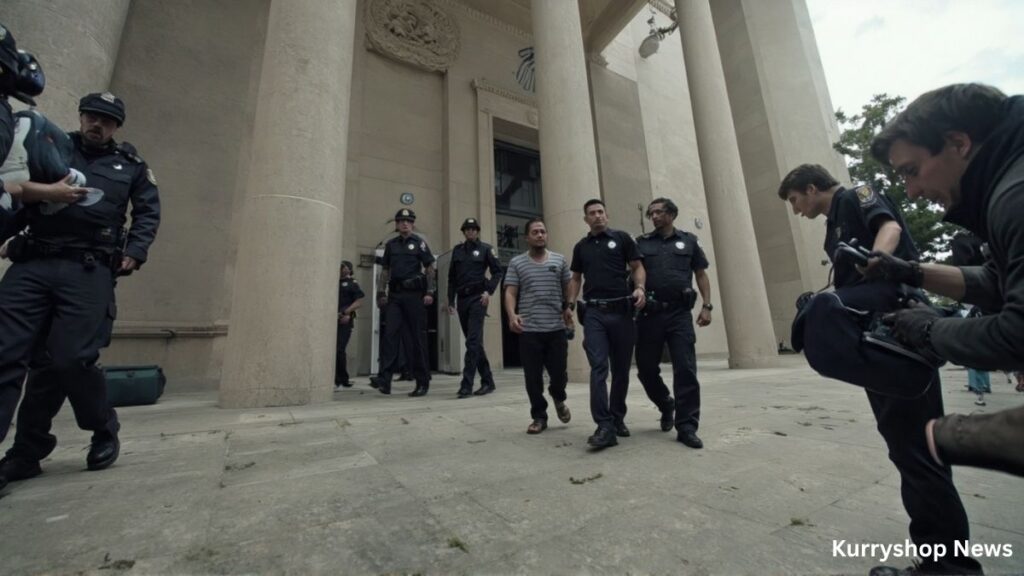

A Case That Exposes Youth Violence, Federal Enforcement and the Struggle for Safety in the Capital
In a dramatic and highly scrutinised development in Washington, D.C.’s crime landscape, federal prosecutors announced the arrests of two young men in connection with a bold August carjacking and assault of a former federal employee. The case has become a flashpoint for broader debates about youth crime, law enforcement jurisdiction and public safety in the nation’s capital.
Exclusive Offer for Our Readers!
Discover an amazing deal available only for our audience. Don’t miss out—act now!
The Attack That Sparked National Attention
On the early morning of August 3, 2025, around 3 a.m., a group of about ten young individuals encircled Edward Coristine (aged 19), a recent staffer for a federal agency, near Swann Street NW in the Logan Circle-14th Street corridor. According to Metropolitan Police Department reports, the assailants demanded his vehicle, forcibly removed the keys and violently assaulted him and the woman he was escorting to her car. Coristine was left with a concussion, multiple contusions and a stripped smartphone.
Investigators say the suspects fled rapidly into a waiting vehicle, but later surveillance and forensics tied two additional suspects — Laurence Cotton-Powell (19) and Anthony Taylor (18) — to the crime via cellphone GPS data, vehicle plate reads and nearby surveillance footage. Both now face multiple federal charges, including attempted unarmed carjacking, robbery with a dangerous weapon, assault with intent to commit robbery, and conspiracy to commit car theft.
The Arrests and Charges
On October 20, federal prosecutors from the U.S. Attorney’s Office for the District of Columbia held a press conference announcing the charges. U.S. Attorney Jeanine Pirro stated, “We will not tolerate the growing menace of young robber crews who target vulnerable individuals in our capital.” The arrests mark a significant breakthrough in a case that had already seen two juveniles (aged 15 and 16) charged in juvenile court for the same incident.
The investigation revealed that the carjacking group travelled in at least two vehicles and had prior surveillance on the victim’s travel patterns. Prosecutors allege that the operation was conducted by a loosely organised youth “crew” that had struck at least one other car-theft scene in the weeks prior, but the Congressional link to a former federal employee elevated the case’s profile.
Exclusive Offer for Our Readers!
Discover an amazing deal available only for our audience. Don’t miss out—act now!
Crime in the Capital: Context and Data
Despite overall declines in violent crime in Washington, D.C. — with bullet incidents down roughly 12 % in 2025 according to MPD data — officials warn that carjackings and youth-related robbery crews are emerging as persistent problems. In FY2024, the DMV area (D.C., Maryland, Virginia) recorded more than 1,300 attempted vehicle thefts, up 7 % year-over-year. Carjacking-related felony cases in D.C. specifically have increased by nearly 30 % since 2022, MPD sources say.
Local policymakers and law-enforcement officials caution that traditional metrics (homicides, shootings) may show improvement, but young offender networks targeting vehicles and pedestrians are growing rapidly. These incidents often occur in early-morning hours and are increasingly captured on viral social-media clips — making them both security and communications crises.
Jurisdictional Clash: Federal vs Local
The involvement of federal law-enforcement agencies (including the FBI and U.S. Attorney’s Office) reflects a shift in strategy. D.C.’s local courts and juvenile system have long faced criticism for lenient sentencing and overcrowded dockets — prompting federal authorities to step in on high-profile cases involving federal employees or inter-state conspiracies.
Debates on Capitol Hill are heating up: some lawmakers argue that giving local agencies more resources is the answer, while others support increasing federal intervention and expanding special task forces to target youth car-theft rings. One key question: should D.C. remain a “local policing domain” or become a testing ground for national-level crime strategies?
Political and Social Repercussions
The Coristine case quickly entered the political narrative. Then-President Donald Trump referenced the incident during several campaign rallies, tying it to his “law & order” platform. He declared, “If you can’t walk safely in the capital of the United States, then we’ve lost control.” Critics, however, accuse the White House of exploiting the case for political gain rather than addressing structural issues such as youth services, economic opportunity and community policing.
Community groups in Logan Circle have voiced mixed reactions: some support the increased federal presence, while others warn that militarising local policing could erode public-trust. Civil-liberties advocates are asking for clearer data on youth arrests, rehabilitation efforts and gang-membership screenings rather than reactive federal crackdowns.
What to Watch: Next Steps in the Case
Key next developments include the following:
- Motions and hearings: Judges are scheduled to handle pre-trial motions in early 2026, where defence attorneys may challenge the admissibility of GPS and cellphone evidence.
- Sentencing decisions: If the case leads to adult charges rather than juvenile prosecution, sentences may exceed 10 years, setting a precedent for other youth crime cases in D.C.
- Policy reforms: D.C. Council members have proposed legislation to create a new “Vehicle-Theft Task Force”, expanding inter-agency cooperation with Maryland and Virginia law-enforcement.
- Industry and commerce impact: Rental-car agencies and civilian transport services are revising insurance models — one insurer noted that claims from early-morning vehicle assaults in D.C. rose 15 % in the past two years.
Exclusive Offer for Our Readers!
Discover an amazing deal available only for our audience. Don’t miss out—act now!
Conclusion
What started as a violent and disturbing incident has evolved into a national story that bridges crime, policy, youth culture and political messaging. The arrests of Laurence Cotton-Powell and Anthony Taylor are not merely about two individuals, but signal a broader shift in how Washington handles the intersection of youth violence and federal law-enforcement. As the city grapples with its identity and safety challenges, the upcoming hearings and policy responses may shape D.C.’s public-safety strategy for years to come.
In a capital where power resides and decisions ripple globally, one stolen vehicle and one violent assault have amplified a debate about jurisdiction, agency and the future of policing.
Sources:
- Business Insider Musk said a group tried to attack a woman before DOGE’s Edward
- The Washington Post Two more teens charged in DOGE staffer attack
- New York Post Teens who jumped ex-DOGE staffer Edward


Your article helped me a lot, is there any more related content? Thanks! https://www.binance.com/register?ref=IXBIAFVY
Can you be more specific about the content of your article? After reading it, I still have some doubts. Hope you can help me.
Thanks for sharing. I read many of your blog posts, cool, your blog is very good. https://accounts.binance.info/tr/register?ref=MST5ZREF