

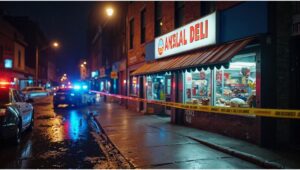
Brooklyn wears its ordinary nights like a second skin. Neon flickers over corner delis, footsteps echo across cracked sidewalks, and the hum of late–summer traffic is the heartbeat of East New York. It’s a rhythm that feels eternal, unshakable—until the moment it isn’t.
Inside one such deli, Diego Sandoval Nava, 33, carried on his work with quiet consistency. He had become part of the neighborhood’s furniture: steady, familiar, always there. His story should have been unremarkable. But sometimes, tragedy doesn’t knock—it barges in.
The demand that cracked everything
The man who entered that night was no stranger. His name was Oneil Millise, 42, and Brooklyn knew him well. Twenty-four arrests trailed behind him like ghosts, yet the system never held him for long. He was always back, drifting between corners, his presence as familiar as it was unsettling.
His demand was small. A “loosie”—a single cigarette. Something so trivial it could have passed without notice. But Diego refused. And with that refusal, something broke.
What followed was not an argument, not a scuffle, but an eruption. Millise’s fury filled the deli. He smashed the payment machine, his rage echoing off narrow walls. Then came the blade—swift, cold, final. In seconds, Diego was gone.
The weight of the absurd
What shakes this story isn’t only its violence but its absurdity. A man’s life ended not in some elaborate crime, not for profit or revenge, but over a cigarette. Over nothing.
Witnesses spoke in whispers afterward, their disbelief etched in trembling voices. “It was over nothing,” one repeated, as if saying it again might make it make sense. But it never would.
Brooklyn has always known crime. But this… this was different. It was a reminder of how fragile life is in the city, how close the ordinary always sits to the catastrophic.
A fugitive with a history of shadows
Millise fled that night, vanishing into Brooklyn’s streets. But his shadow remained—his rap sheet long enough to write its own prophecy. Two dozen arrests, countless chances, and a system that seemed unable—or unwilling—to stop the cycle.
Now, his name carries more than notoriety. It carries fear. And it leaves the neighborhood asking why. Why was he still free? Why did it take Diego’s blood to expose the cracks already split wide open?
The lingering question
As the city lights continued to glow, Brooklyn went on. Cars honked, trains rattled, conversations filled bodegas. But beneath the surface, something lingered.
Because Diego’s death wasn’t just another crime statistic—it was a mirror held to the city’s face. It showed the razor-thin edge between calm and chaos, between ordinary and fatal.
And in that reflection, one haunting question refuses to fade:
How many more Diegos must fall before the cycle finally breaks?


Your article helped me a lot, is there any more related content? Thanks!