
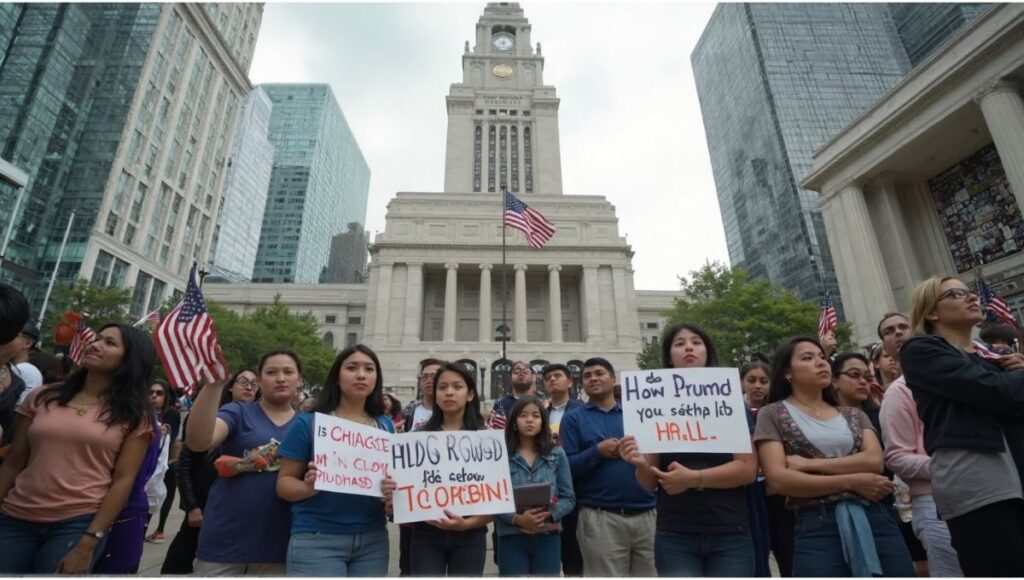
In a striking move that could reshape the balance between local and federal power, Chicago Mayor Brandon Johnson signed an executive order this week prohibiting the city’s police department from cooperating with federal immigration enforcement efforts. The decision, made in direct defiance of President Donald Trump’s expanded immigration crackdown, has triggered both celebration and controversy across the United States.
While the White House insists that deploying federal agents is essential to fighting crime, critics argue that such tactics are unconstitutional, harmful to immigrant communities, and a dangerous overreach of executive power. Johnson’s order now places Chicago at the center of a national debate over civil rights, immigration, and the future of urban governance.
A City’s Legacy of Resistance
Chicago has long been known as a “sanctuary city,” offering protection and support to immigrant residents regardless of their legal status. Mayor Johnson’s latest move reaffirms that legacy but takes it a step further: under the new order, Chicago police officers are forbidden from participating in immigration raids, checkpoints, or identity-based policing.
“The Constitution demands that local governments serve their residents, not the political ambitions of Washington,” Johnson declared during a press conference at City Hall. Supporters applauded his stance, arguing that community trust and public safety depend on ensuring immigrants are not afraid to seek help from local authorities.
Federal vs. Local Authority
President Trump’s administration, however, has framed the mayor’s decision as reckless. Federal officials claim that Johnson’s executive order undermines national security and hampers efforts to remove individuals with criminal records. “We will not allow sanctuary cities to shield dangerous criminals from justice,” Trump said during a rally in Ohio.
Legal scholars warn that the showdown could head to federal court. The Constitution does not explicitly require local law enforcement to carry out federal immigration laws, but the Trump administration may attempt to penalize Chicago by withholding federal funding. This raises critical questions: How far can the federal government go in pressuring cities, and to what extent can cities resist?
Communities Divided but Determined
For immigrant communities in Chicago—particularly Latino and Asian American neighborhoods—the order represents more than politics. “This is about survival,” said María Torres, an immigrant rights activist in Pilsen. “Families live in constant fear of deportation. When local police collaborate with ICE, it tears our communities apart.”
Opponents, however, see the decision as prioritizing politics over safety. Some Chicago residents worry that limiting cooperation with federal agents could allow undocumented individuals with serious criminal backgrounds to avoid accountability. The city’s police union has also expressed concerns about conflicting instructions between local and federal agencies.
National Implications
Chicago’s defiance is not an isolated incident. Across the country, several cities and states are resisting Trump’s aggressive immigration agenda. California, New York, and Massachusetts have all taken steps to limit cooperation with Immigration and Customs Enforcement (ICE). Yet Chicago’s direct prohibition on collaboration marks one of the most significant challenges to date.
The decision is expected to fuel wider political battles ahead of the 2026 midterm elections, as immigration remains a central campaign issue. Democrats have largely praised Johnson for standing firm, while Republicans argue the move endangers public safety and undermines federal authority.
The Broader Debate on American Values
At its heart, the Chicago controversy highlights a deeper question: What kind of nation does America want to be? Should the U.S. prioritize strict enforcement of immigration laws, or should it uphold local autonomy and humanitarian protections for immigrant families?
Mayor Johnson’s order forces Americans to confront these questions directly. In his words: “Chicago will not be a staging ground for unconstitutional crackdowns. We will be a city that stands for dignity, fairness, and the rule of law.”
Whether the courts, Congress, or the public side with Johnson—or with Trump—will determine not just the fate of Chicago’s immigrants but also the future of American federalism itself.
Sources
- The Guardian, “Trump news at a glance: Backlash in Chicago as mayor defies president’s immigration crackdown” (Aug. 31, 2025).
- Reuters, “Political standoff intensifies over Trump’s plans in Chicago crackdown” (Aug. 31, 2025).
- Associated Press, “Government shutdown looms as Congress returns” (Aug. 31, 2025).



Thanks for sharing. I read many of your blog posts, cool, your blog is very good. https://www.binance.com/ro/register?ref=HX1JLA6Z
Your point of view caught my eye and was very interesting. Thanks. I have a question for you. https://accounts.binance.info/en/register?ref=JHQQKNKN
Your point of view caught my eye and was very interesting. Thanks. I have a question for you.
Your article helped me a lot, is there any more related content? Thanks! https://www.binance.info/register?ref=IXBIAFVY
Can you be more specific about the content of your article? After reading it, I still have some doubts. Hope you can help me. https://www.binance.com/si-LK/register?ref=LBF8F65G