
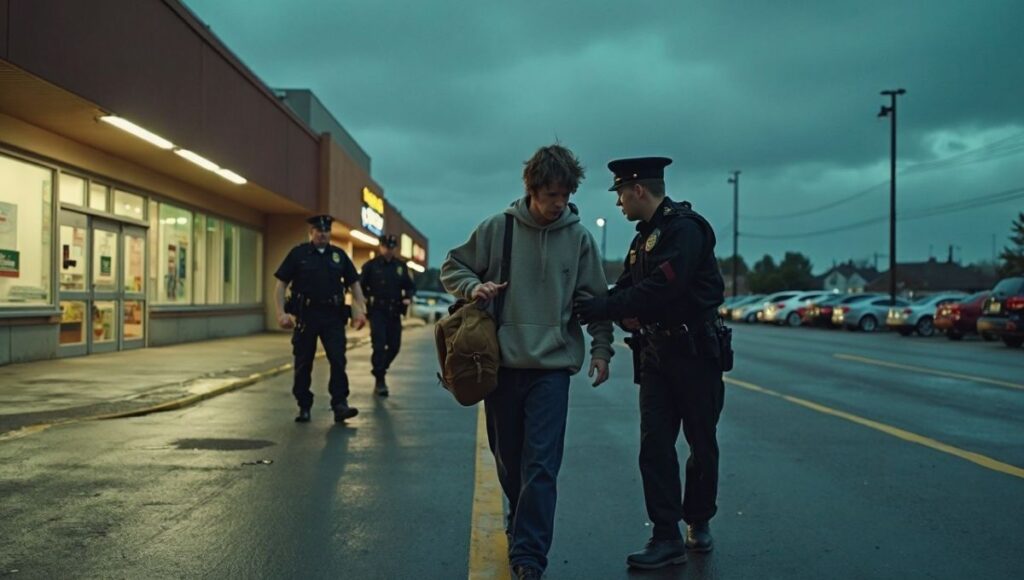
It was the kind of California afternoon that passes without notice—sunlight spilling over asphalt, the hum of traffic weaving its endless song, and shoppers pushing carts loaded with the simple comforts of life. Pico Rivera was quiet, unremarkable. And then, in a single breath, that quiet shattered.
What happened in that supermarket parking lot did not feel real. It felt staged, cinematic—except that no director yelled cut, and no actors walked off the set.
The Spark
Adrian Andrew Martinez was twenty years old, and by most accounts, unremarkable too—until the moment he wasn’t. Witnesses say he stepped forward, his voice breaking into the rhythm of the day as federal officers closed in on an elderly man. His words rose, urgent and sharp, cutting through the ordinary hum.
Then came the shift. Cameras caught fragments of it: officers advancing, a tangle of limbs and shouts, the crack of bodies hitting pavement. Metal cuffs clamped shut, the sound sharp enough to slice through the air. In seconds, the young man who had spoken became the young man on the ground.
The Firestorm
By nightfall, the footage was everywhere. On phones, on televisions, on timelines—an echo of chaos replayed endlessly. And with each replay, the story grew heavier, darker, more contested.
Some saw courage in Martinez, a defiant act against a system too powerful, too willing to silence dissent. Others saw recklessness, a dangerous outburst that turned a tense moment into something more volatile.
The narrative bent with every opinion, every headline. But one truth emerged: a nation that had not been watching Pico Rivera was now watching intently.
The Weight of the Law
Federal prosecutors wasted no time. Their narrative was colder, sharper: Martinez was not a bystander but a conspirator, a man who had crossed from protest into obstruction. Their words carried the weight of consequence—up to six years in prison if the charge holds.
But here lies the fracture. The footage is incomplete, blurred at the edges, full of silences where truth could live. Did Martinez strike an officer? Or did the chaos itself create a story more convenient than factual?
Between the legal filings and the viral video lies a canyon of uncertainty, and in that canyon, a young man’s future hangs suspended.
The Silence After
The supermarket has moved on. Cars come and go, grocery carts rattle, bags of bread and milk change hands. Yet for those who saw, for those who felt the crackle of tension in that parking lot, the silence is not silence—it’s memory. Memory that clings like smoke long after the fire is gone.
Every community knows this truth: the ordinary can fracture without warning. One moment you are living in the rhythm of a quiet afternoon. The next, you are watching that rhythm torn apart by power, resistance, and the fragile thread that binds freedom to restraint.
The Question That Won’t Fade
As night falls again over Pico Rivera, the story refuses to settle. It lingers in the air, in the voices of those who argue over its meaning, in the silence of those who fear what it represents.
Was Adrian Andrew Martinez a reckless agitator—or a young man caught in the machinery of power? Was justice delivered that day—or was it denied before it ever had a chance to speak?
The answers do not live in the footage alone. They live in the shadows cast by that afternoon, shadows that stretch longer with each retelling.
And perhaps that is the most unsettling truth of all: that the line between ordinary and extraordinary, between silence and uproar, between justice and injustice, is as thin—and as fragile—as the air of a quiet California afternoon.

Your point of view caught my eye and was very interesting. Thanks. I have a question for you. https://www.binance.info/zh-TC/register?ref=DCKLL1YD