
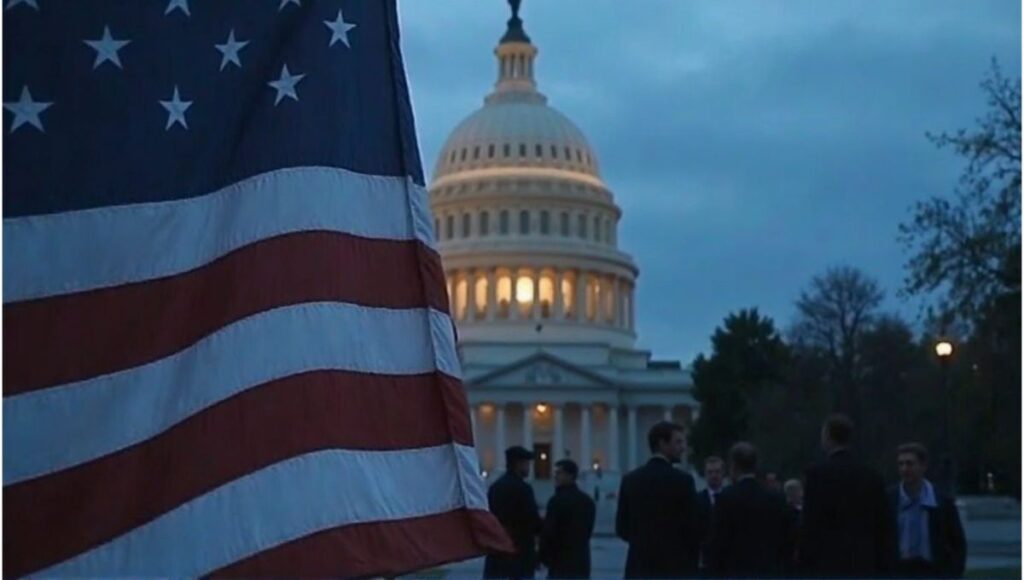
A Flag in Flames, A Nation on Edge
On a humid August morning, the quiet streets of Washington D.C. cracked open with a sudden announcement. President Trump signed an executive order making the burning of the American flag a punishable crime. For decades, the Supreme Court had treated flag burning as a symbol of free speech — an untouchable right, wrapped in the First Amendment. Now, the order felt less like a piece of policy and more like a strike of lightning across the fragile balance of democracy.
The move sparked both roaring approval from his base and fierce condemnation from civil liberties advocates. To Trump’s supporters, it was a patriotic stand against “disrespect.” To critics, it was the first domino falling toward a broader attack on free expression in America.
Cracks in the Democratic Party’s Armor
While Republicans consolidated around Trump’s hard-line approach, Democrats gathered in Minneapolis for their summer meeting. What was meant to be a strategy session turned into a battlefield of ideas. Younger progressives demanded a stronger stance on the Israel-Gaza war, calling for an arms embargo and humanitarian-first policies. Party veterans, wary of alienating traditional allies, pushed back with a more measured call for ceasefire diplomacy.
The scene was less of a conference and more of a generational clash — one that highlighted a growing divide within the Democratic Party. For voters watching from home, it painted a picture of a fractured opposition at the very moment when unity was most needed.
The Red Map and the Future of Power
Behind the headlines, a quieter but equally seismic shift was unfolding. Republican-led states began redrawing congressional maps, carving districts with surgical precision. Analysts warned this “redistricting push” could cement Republican control of the House of Representatives for decades.
In small offices across state capitals, demographic data and political algorithms were shaping the future of American representation. The question whispered in Washington’s halls was chilling: Is democracy being slowly engineered into irrelevance?
The Fall of a Federal Reserve Guardian
If politics is America’s stage, the economy is its lifeline. That lifeline shook when Trump abruptly fired Federal Reserve Governor Lisa Cook, citing vague allegations of real estate fraud. For markets, the issue wasn’t the accusations — it was the precedent.
For more than a century, the Federal Reserve has stood as a firewall between politics and the dollar. By dismissing a sitting Fed official on questionable grounds, Trump signaled that the central bank might no longer be shielded from political storms. Investors whispered about the “politicization of money,” a phrase that could spook Wall Street for years to come.
Soldiers in the Streets
The drama did not end in boardrooms or committee halls. Across several major U.S. cities, the National Guard appeared with live weapons in hand. Officially, they were deployed to “maintain order.” But to many Americans watching armed patrols under the glow of city streetlights, it felt eerily reminiscent of martial law.
Governors and civil rights groups erupted in protest, calling the move both unnecessary and unconstitutional. Still, the sight of soldiers guarding ordinary neighborhoods carried a powerful — and polarizing — message: the White House was ready to govern not just with laws, but with force.
Democracy at a Crossroads
Taken together, these developments sketch a chilling portrait of America in transition. An executive order curbing free speech. A party divided against itself. Maps redrawn to lock in power. A Federal Reserve rattled by political interference. Soldiers patrolling the nation’s capital.
This is not a single story, but a web of converging crises — political, legal, economic, and cultural. Each headline is a brushstroke, and together they paint a larger canvas: a democracy under pressure, a republic where the rules that once seemed unbreakable are suddenly negotiable.
For readers, the question is not whether these events matter. The question is how long America’s democratic fabric can hold before the seams begin to tear.


Your article helped me a lot, is there any more related content? Thanks! https://www.binance.com/register?ref=IXBIAFVY
Thank you for your sharing. I am worried that I lack creative ideas. It is your article that makes me full of hope. Thank you. But, I have a question, can you help me?
Can you be more specific about the content of your article? After reading it, I still have some doubts. Hope you can help me.