
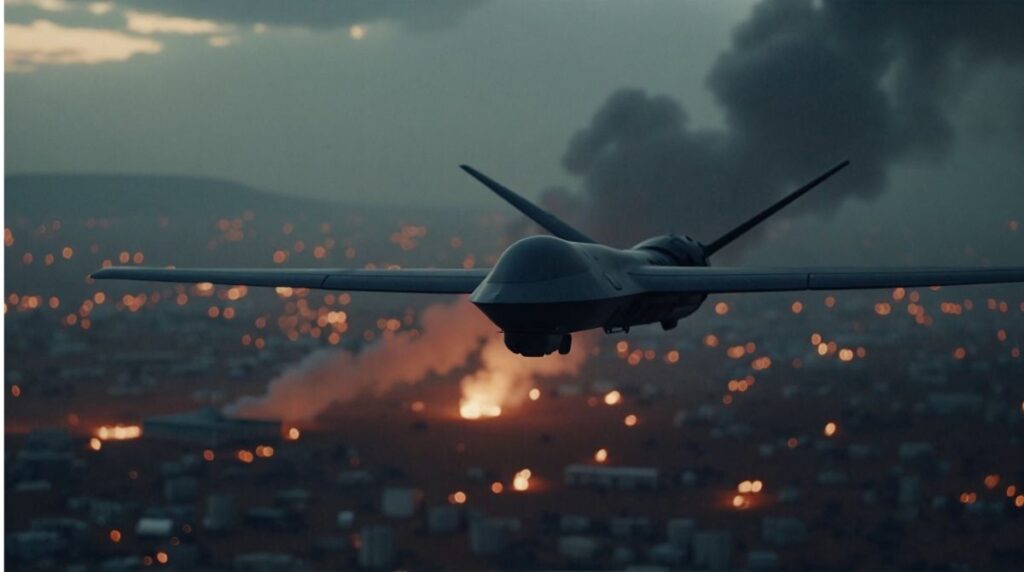

In a new revelation reported by Reuters, U.S. intelligence agencies are reportedly providing critical support to Ukraine in identifying and targeting elements of Russia’s energy infrastructure — a move that underscores Washington’s deepening role in the ongoing war. The assistance, though not officially confirmed by the White House, highlights how intelligence sharing has become one of the most significant tools in Ukraine’s effort to counter Russia’s war machine.
Exclusive Offer for Our Readers!
Discover an amazing deal available only for our audience. Don’t miss out—act now!
A Strategic Pressure Point
According to sources familiar with the matter, U.S. intelligence services have supplied Ukraine with detailed data on Russian energy facilities, including power grids, refineries, and fuel depots. These structures, considered vital for sustaining Moscow’s war operations, have increasingly come under drone and missile attacks in recent months.
While Washington maintains that it does not directly select or approve Ukrainian targets, officials say that the intelligence sharing falls under the umbrella of “defensive support.” The underlying strategy, analysts say, is to pressure Russia economically and logistically, rather than escalate the conflict into a direct confrontation.
“This kind of cooperation shows how far intelligence sharing has evolved,” said Michael Kofman, a defense analyst at the Carnegie Endowment for International Peace. “It allows the U.S. to weaken Russian capabilities without crossing the threshold of direct military engagement.”
Energy Infrastructure: The Soft Underbelly
The attacks on Russia’s energy infrastructure have become a key component of Ukraine’s asymmetric strategy. With limited air power, Kyiv has relied heavily on long-range drones and precision strikes to target refineries and power stations that feed the Russian military-industrial complex.
Recent reports indicate a sharp rise in explosions and fires at oil facilities in regions like Bryansk, Belgorod, and even deep into Tatarstan — areas previously considered beyond Ukraine’s reach. Russian officials have accused Western countries, especially the United States, of complicity in what they call “acts of terrorism.”
However, Ukrainian defense sources argue that the strikes are legitimate acts of war against military-linked infrastructure fueling the invasion. “Russia uses its energy profits to finance the war, and its logistics depend on these systems,” a Ukrainian military officer told Reuters. “By hitting them, we disrupt their entire chain of command and supply.”
Exclusive Offer for Our Readers!
Discover an amazing deal available only for our audience. Don’t miss out—act now!
Washington’s Balancing Act
The revelation of U.S. involvement through intelligence sharing comes at a politically sensitive time. The Biden administration has been walking a fine line — supporting Ukraine with weapons, funding, and real-time battlefield intelligence while avoiding actions that could provoke a wider confrontation with Moscow.
A senior U.S. official speaking anonymously told Reuters that the intelligence provided “helps Ukraine understand vulnerabilities in Russia’s logistics and command networks,” but emphasized that “the final decision on targets is entirely Ukraine’s.”
Privately, however, U.S. defense insiders acknowledge that the coordination between Washington and Kyiv has become far more sophisticated than at any earlier stage of the war. “The intelligence flow is constant,” said a former Pentagon official. “It’s no longer just about troop movements — it’s about power grids, supply chains, and cyber vulnerabilities.”
Moscow’s Response
The Kremlin reacted strongly to the Reuters report, warning that “U.S. complicity in attacks on Russian infrastructure will have consequences.” Russian Foreign Ministry spokesperson Maria Zakharova described the alleged intelligence support as “an act of aggression in disguise” and hinted at possible retaliatory measures, both diplomatic and cyber.
Meanwhile, Russian state media has been pushing narratives suggesting that the U.S. is “escalating the war” and “dragging NATO into a direct confrontation.” However, Western analysts note that such rhetoric has been a consistent part of Moscow’s messaging since the early stages of the conflict.
Exclusive Offer for Our Readers!
Discover an amazing deal available only for our audience. Don’t miss out—act now!
The Bigger Picture: Energy as a Weapon
Energy has always been at the center of the Russia-Ukraine conflict — not just as an economic factor, but as a tool of geopolitical leverage. Russia’s vast network of oil pipelines, refineries, and power plants fuels both its economy and its war effort. Disrupting this network hits Moscow where it hurts most — its pocket.
For Ukraine, striking Russian energy assets serves a dual purpose: weakening the enemy’s resources and sending a message that no part of Russia’s war infrastructure is beyond reach. As the war grinds into its third year, such tactics reflect a shift toward long-term strategic disruption rather than short-term territorial gains.
Global Repercussions
The escalation in attacks has also sparked concerns about global energy stability. A series of refinery fires and supply interruptions inside Russia have already caused fluctuations in international oil prices. Experts warn that a prolonged campaign could ripple through global markets, further tightening energy supplies ahead of winter.
“The longer this goes on, the more likely we’ll see price shocks and supply chain disruptions,” said Ellen Wald, an energy analyst and author of Saudi, Inc. “Every time a refinery or power plant goes offline, the ripple effects are global.”
Exclusive Offer for Our Readers!
Discover an amazing deal available only for our audience. Don’t miss out—act now!
A War Without Borders
As Ukraine continues to expand its reach using Western intelligence and homegrown drone technology, the nature of modern warfare is evolving. The battlefield is no longer confined to trenches and tanks — it now includes satellites, cyber operations, and shared data between allies.
For Washington, the challenge will be maintaining support for Kyiv without triggering a confrontation that neither side wants — but both continue to approach dangerously close.
Sources:
- Reuters — “US intelligence helps Ukraine target Russian energy infrastructure, FT reports”
- Financial Times (FT) —Ukraine hit Russian energy sites with US help


Thank you for your sharing. I am worried that I lack creative ideas. It is your article that makes me full of hope. Thank you. But, I have a question, can you help me? https://accounts.binance.com/es-AR/register?ref=UT2YTZSU
Can you be more specific about the content of your article? After reading it, I still have some doubts. Hope you can help me.
Can you be more specific about the content of your article? After reading it, I still have some doubts. Hope you can help me.
Your point of view caught my eye and was very interesting. Thanks. I have a question for you.